

Rethinking How Islamic Schools “Do” Religious Education
On April 21, Afeefa Syeed, founder of the Center for Innovative Religious Education (CIRE) and co-founder of a full-time Islamic school in Virginia, Al Fatih Academy, provided a crucial and thought-provoking webinar, Teaching Religion, Building Understanding. The session invited educators to reimagine how religious education is taught—and more importantly, how it is experienced— within faith-based schools.
Rather than focusing solely on content delivery, the conversation centered on engaged religious education: a way, a method, and an approach to be more engaged, intentional, holistic, and rooted in real-life application. The goal is not simply to teach students about religion, but to help them develop a meaningful, lived understanding of their faith.
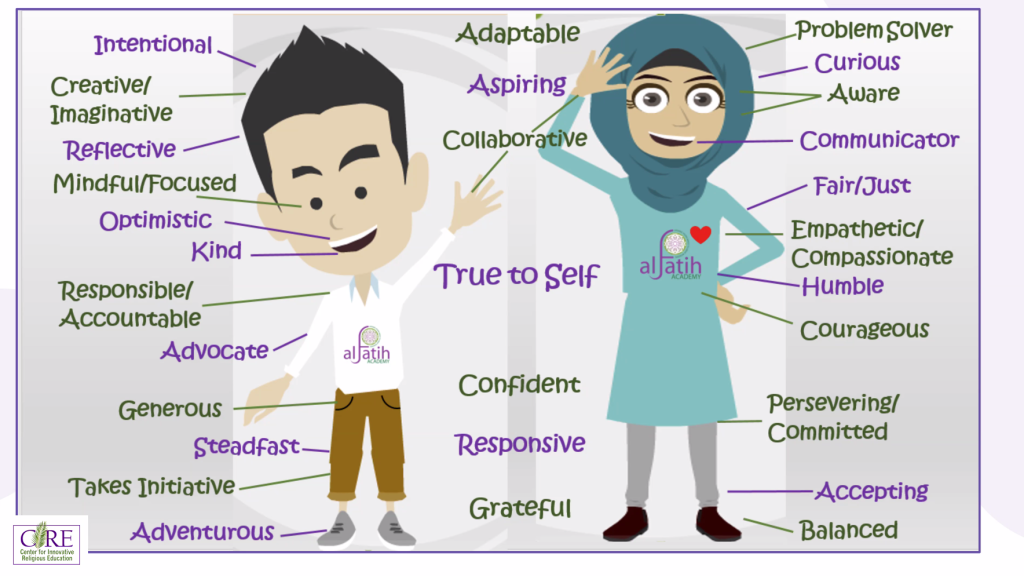
A diagram that shows what Al Fatih Academy hopes students will develop through their experiences at the school.
From Information to Transformation
Sister Afeefa began by sharing a powerful reflection from a recent 7-day journey across the Sahara Desert. She described making sujood in the sand and timing how long it took for the imprint of her hands to disappear—just one minute. Yet while the physical imprint on the sand faded quickly, the imprint in her would remain.
This idea resonated deeply with participants. As one shared:
“Your sujud is recorded eternally in another plane, and those grains of sand will bear witness to your sujud. It’s just that we can no longer see it. The moments move forward, but the imprint is there, albeit invisible. Sometimes, actually oftentimes, that is analogous to the impact that we have on each other.”
This distinction challenges educators to think beyond what is visible or measurable. In the same way that footprints in the sand disappear, classroom moments may seem fleeting—but the deeper impact on students’ hearts, identities, and sense of purpose can endure.
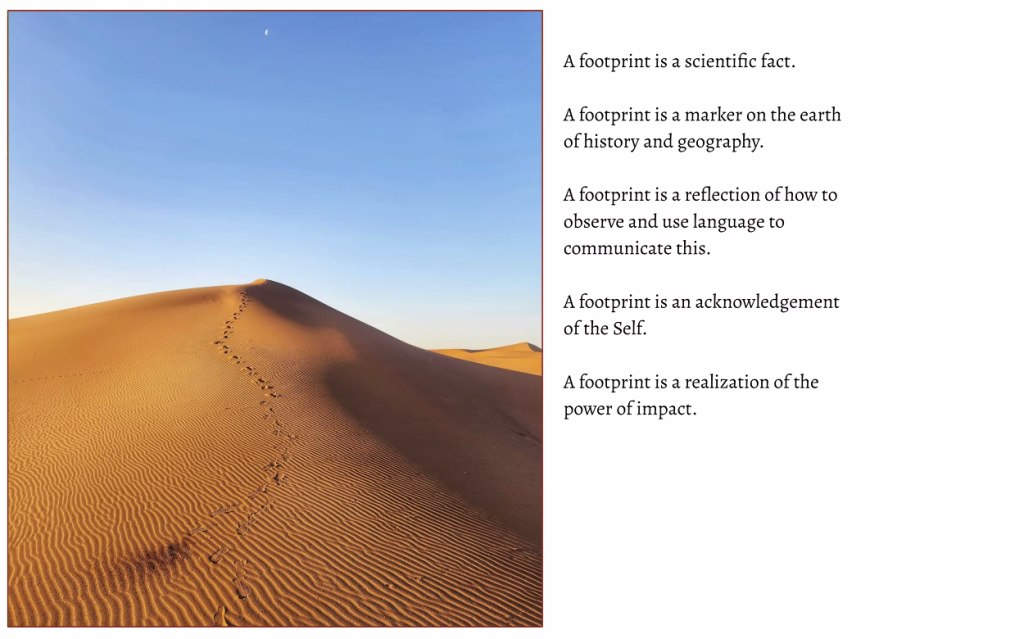
Photo Afeefa Syeed took during her 7-day journey across the Sahara Desert.
A Holistic Framework for Engaged Learning
Sister Afeefa encouraged educators to reflect on how religious education is experienced across the entire school environment—not just within a single class period, but through culture, routines, and relationships.
Values & Beliefs
How do students process and support their beliefs, and how do school frameworks reflect this? Creating space for exploration and ownership is key.
Intentional Action
What does intentionality mean in practice? Examples shared included “intention trees” where teachers name their goals for the year, integrating service into daily routines, and connecting charitable actions directly to purpose.
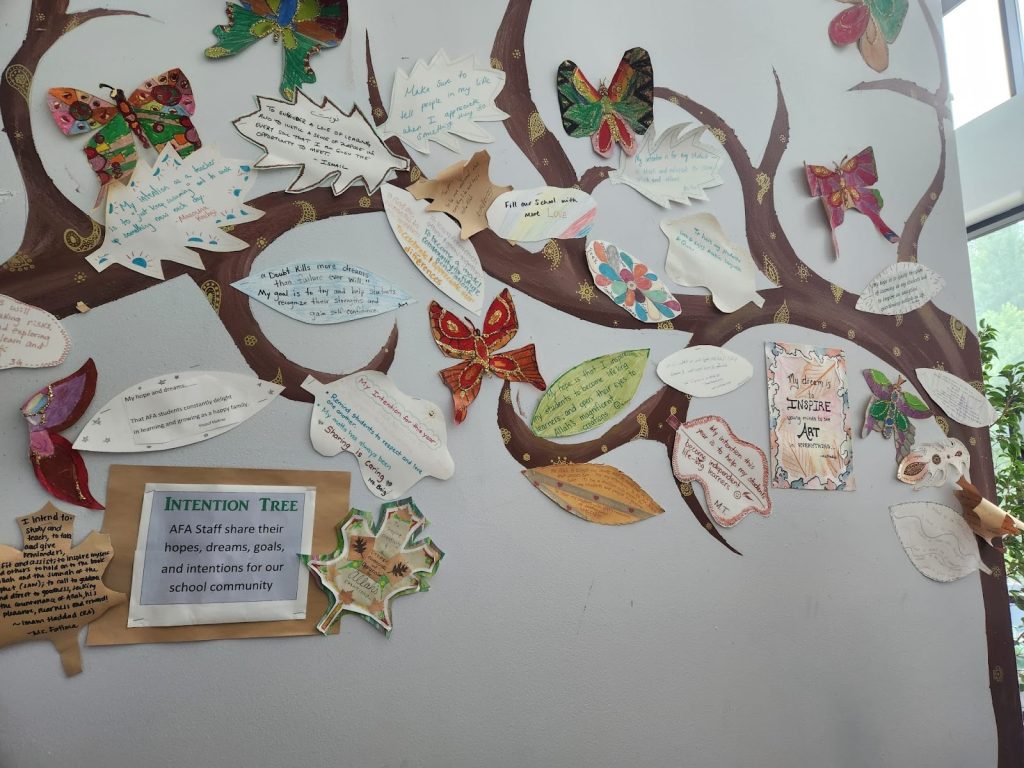
Photo of an “Intention Tree” with teachers’ intentions displayed in the school halls of Al Fatih Academy (VA).
Relationship
How we create, nurture, and impact relationships—what we say and what we do—shapes how students understand and live their faith.
Meaning & Purpose
Students should be encouraged to ask critical questions: What is my purpose? How is my worldview shaped by my beliefs? How do I understand and engage with different perspectives?
Awe & Wonder
A recurring theme from participants was the challenge of making space for awe:
“We don’t have time for awe and wonder, while trying to finish the curriculum.”
Yet without these moments, learning risks becoming disconnected. Creating intentional opportunities—through reflection, nature, or open-ended exploration—helps nurture a deeper connection to the Divine.
Self-Knowledge & Transformation
Religious education should create transformative experiences—moments that connect students to something deeper and help them navigate life’s complexities with resilience and spiritual grounding.
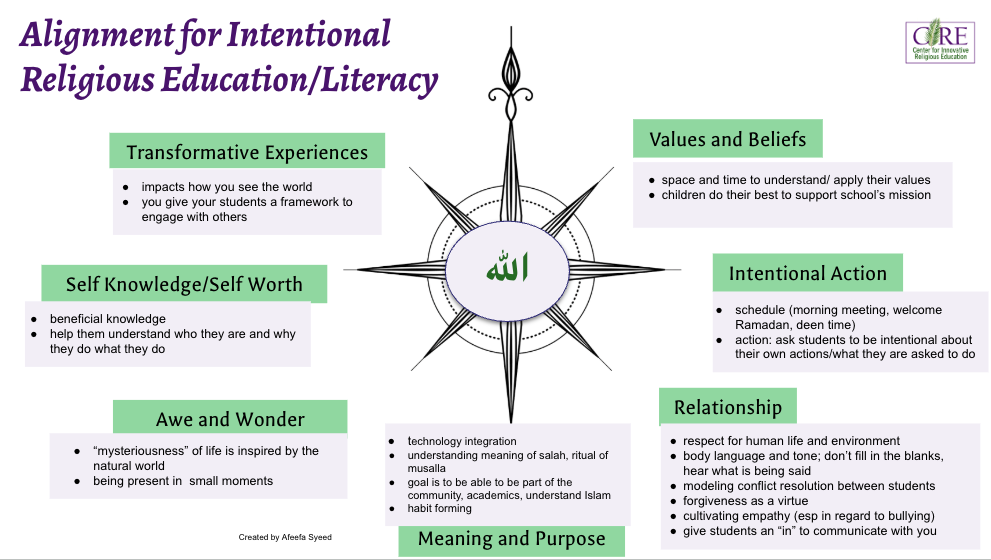
7 point compass showing how religious education/literacy is developed.
Practical Applications in Schools
The session offered concrete ways schools can begin implementing engaged religious education:
- Build intentional practices into the school day—morning reflections, communal acts of service, and visible reminders of purpose
• Use place-based learning to connect students to their environment, community, and history
• Integrate interdisciplinary learning, bringing together different areas of knowledge into a cohesive whole
• Start with what students already know—one participant noted that this approach often reduces how much “content” needs to be taught while increasing engagement
• Create space for reflection and inquiry, allowing students to wrestle with meaning, purpose, and identity
These practices shift students from passive recipients of knowledge to active creators—making their own connections and developing a sense of ownership over their learning.
Opportunities for Growth
Teaching religion today includes navigating questions of difference, diversity, and inquiry. Rather than avoiding these tensions, the session emphasized their value. When students are encouraged to engage thoughtfully with different perspectives, they build empathy, reduce prejudice, and strengthen their ability to participate in a diverse society.
Faith-based schools are uniquely positioned to do this well—modeling how to hold both conviction and openness, grounded in spiritual values.
Looking Ahead
This webinar served as a meaningful reminder that religious education is not just about what students learn—it is about what stays with them.
Just as the imprint of sujood may disappear from the sand but remain within us, the experiences we create in our classrooms have the potential to leave lasting impressions on our students’ hearts, identities, and sense of purpose.
🎥 Watch the full webinar recording
https://www.youtube.com/watch?v=tQQv6gbayU4
🔗 Learn more about the Center for Innovative Religious Education (CIRE): https://www.cire-us.org/
Contact:
- For folks to see more info about the integrated curriculum project and broader related work: https://www.afacire.org/
- Contact Afeefa Syed: afeefa.syeed@alfatih.org
