

What is the Islamic School Directory and Interactive Map?
To make sure every full-time Islamic school operating in the United States is on its Interactive Map and School Directory, ISLA is asking you to tell us if your school is on the map. Drawing from our internal directory, there are already nearly 450 full-time Islamic schools.
However, some may have closed down, merged with others, or new ones may have opened up.
In order to accomplish our ambitious goal and share this free resource accurately with the American Muslim community, we need your help!
We are asking individuals and educators to access the map, filter it by region or state, and identify if any schools have closed, opened, merged or are simply missing! After taking a look at the regions on the map that you’re most familiar with, click on “Map Every School” button to inform us of what you found.
If you are professionally affiliated with a new school that is missing from the map, you can do so via the “Update/Add School” button. This is also a great opportunity for existing schools to update their profiles through the same button so that people have the most updated data about them. The more information you share in your profile, the easier it will be for prospective families and employees to find your school.
Many individuals use the map to identify where to settle down with their families. Others use it to gauge the vibrancy of the Muslim community. Make sure your school is not missing from the map. Check it out and let us know what’s missing or needs updating!
Why Does Data Matter?
ISLA uses the database to be able to report on the state of Islamic schools in the U.S. for research papers and reports, and even for advocacy. We need concrete, reliable data to be able to tell the story of Islamic schools, internally and externally.
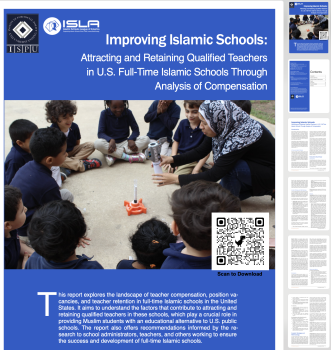
Islamic school boards and administrators are forced to frequently make strategic decisions in a vacuum due to lack of relevant information. For Islamic school board members, administrators and community members, reports from the ISLA’s Database Project can help them make more effective decisions by providing them with comparative or landscape data from which they can benchmark their own datapoints. For example, a report ISLA co-published with ISPU on hiring and retention provided valuable insights into the average salaries for Islamic school educators, as well as recommendations for improving retention at our schools from our last round of data collection.
Without reliable data, the potential for sector-wide collaboration and shared learning is severely limited, hindering the growth and impact of these institutions. The ISLA Database Project advances our understanding of Islamic schools in the U.S. and makes them visible in the larger American society as a permanent fixture to be recognized in the overall faith-based private educational sector. Adding your school to the Directory literally puts you on the map! And, it helps us collect data from the most comprehensive population of Islamic schools possible, resulting in more comprehensive insights that benefit both Islamic school educators and leaders and the community as a whole.
What’s Next? Survey of School Leaders
Stakeholder Input Needed!
Along with ensuring that our Directory contains the most accurate data on Islamic schools across the U.S., ISLA will also be sending out a survey in the near future to Islamic school leaders to study the landscape nationwide. The survey will seek to identify key characteristics of the schools, identify challenges and opportunities, report on growth trends, and fill important knowledge gaps concerning full-time Islamic schools.
To ensure that the survey asks the right questions, we are also inviting various stakeholders such as school leaders, board members, teachers, parents, service providers, and researchers to give us their input. If you’re interested in being part of the survey-building process or have any queries, please reach out to Saulat Pervez, Database Project Director, at spervez@theisla.org. Your feedback will help us refine the survey that will be going to all the full-time Islamic schools to help us understand the state of Islamic schools in the U.S.
The directory and survey results will give vital insights into the vast field of Islamic schooling in order to both respond to its needs and work towards its betterment in an efficient manner. The data results will be relevant not only for those serving the Islamic school community, such as board members, administrators, teachers, parents, educational researchers, and educational service providers but also the broader Muslim American community.
The survey results will further serve a secondary, yet equally important, function: Giving us the ability to tell the story of Islamic schools with accurate data that works to dispel myths about Muslims while shining a light on the contributions Muslims have and continue to make in this country.
So, what are you waiting for? Discover the Directory. Let’s build this vital resource together!
