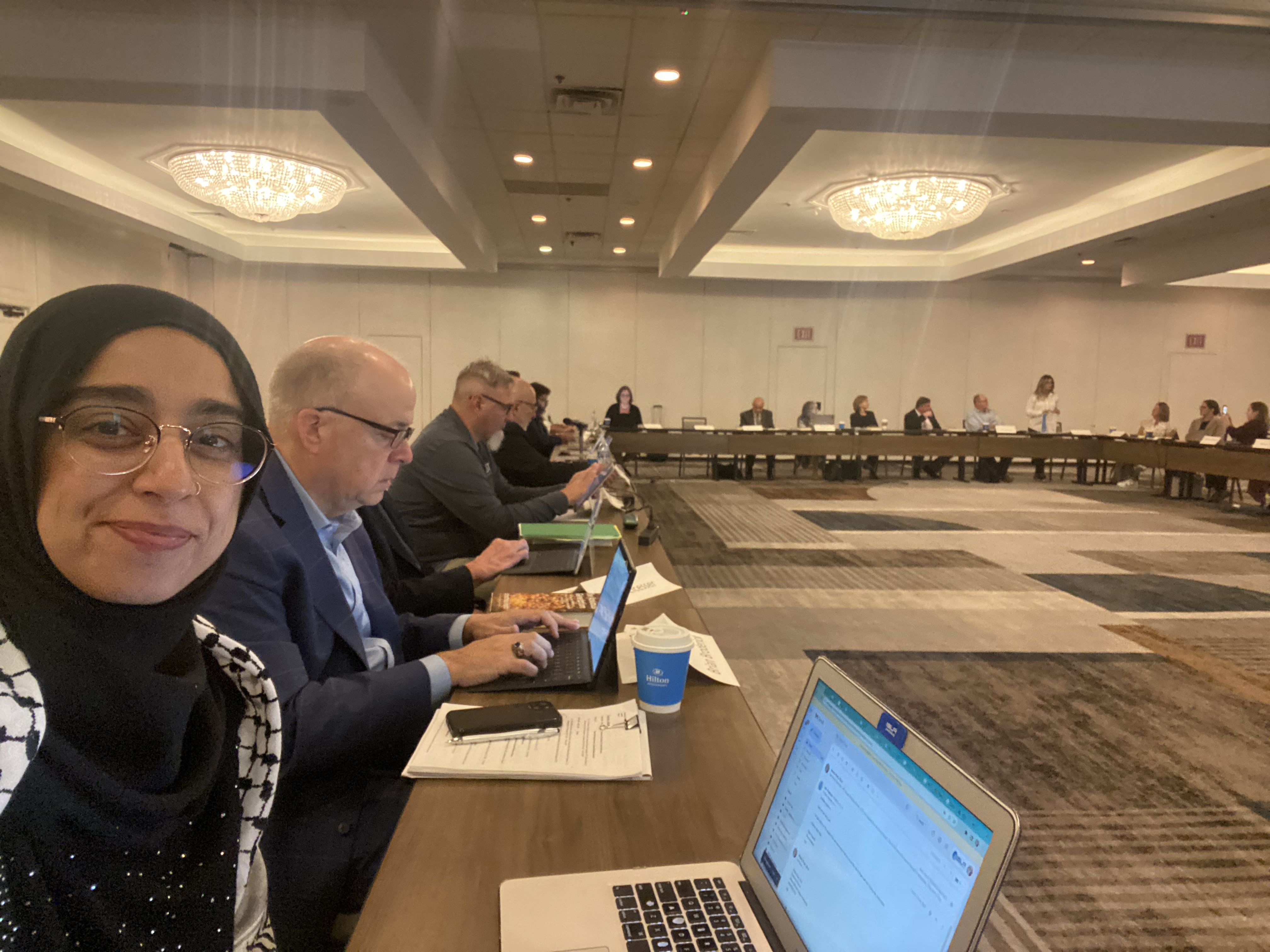
The Council for American Private Education biannual meeting recently took place in Washington, DC, September 17-18, 2024. It was a powerhouse of people, presenters and ideas, mashallah!
CAPE Board Members and Sponsors, representing between 3-4 million students in the United States!
What is CAPE?
From their website: “The Council for American Private Education (CAPE) is a coalition of national organizations and state affiliates serving private elementary and secondary schools.”
Islamic Schools have a seat at the table!
Together, the CAPE board members, of which ISLA and CISNA are both members, represent 3-4 million students who attend private schools across the United States!
Member schools make it possible for us to have a “seat at the table” because your membership dues make it possible for us to pay for membership in CAPE and travel to Washington, DC biannually for the meetings.
The elite professional development, insights into upcoming and current legislation impacting private schools, and connections with other national and global educational leaders are priceless! We try to pass along the knowledge and wisdom gained from these trips through presentations at ISLA’s monthly admin meetings and our blog posts and reports.
Fall 2024 Meeting Summary
This September’s meeting was filled with reminders that we are educating young people in a rapidly changing world… Perhaps, in a world in which we can no longer even fathom what the near future has in store.
Many of the highlights from this meeting are captured in my meeting notes and the presentation slide decks that we received. I invite you to peruse through these notes.
Education in a Rapidly Changing Global Context
If you have time, definitely check out the slide deck on Education in a Rapidly Changing Global Context, which has some intriguing statistics on how other countries are doing in various domains… and what sets the top performing countries apart from the United States (which is lagging far behind)!
The presenter shared five themes found in countries that have the highest performing students (while also taking into account other measures of their well-being, like resiliency, equity, and life satisfaction).
What’s working? Commonalities amongst the highest performing countries
Proficiency-Based Learning System
A clear performance standard
Student work illustrates the standards
Benchmarks along the way
Relentless focus on ensuring all students stay on track to that goal
2. Assessment for learning
Provide teachers and students clear info about progress & challenges
External assessments only at key levels
Designed to ensure students are ready for next level
3. Well-designed curriculum
Pedagogically and developmentally appropriate
Targeted at what is most important
With rigorous personalized pathway options in high school
4. Early learning & supports
Including early intervention
Ensure readiness for learning
Wraparound services & targeted academic support
Sometimes provided by family systems and others by the government
The presentation on Generative AI was also very fascinating. While many of us had heard of and used ChatGPT, we also learned about many more artificial intelligence tools that can be used for helping you plan your dinner based on what ingredients are in your fridge or pantry, to being able to decipher if you can park on the street on a Tuesday evening, to researching a specific topic from peer-reviewed journals only, to summarizing hours and hours of video content into a brief note.
One gem from this presentation especially relevant for educators was: “If you are assigning homework that ChatGPT can do, then you are assigning the wrong homework”
Reflections and Questions for Islamic School Educators in the U.S.
The world really is rapidly changing. And what we find from the research that was shared with us at CAPE is that US schools are not the best in the world!
I know this is no surprise to most of us, but it begs the following questions:
Do our Islamic schools look to their public schools to determine which curricula to use? If so, why?
Have we adopted the same measures of ‘achievement’ and ‘success’ that are popular in the United States? Have we critically analyzed if these are the measures we wish to use? Are there alternative, more comprehensive and valid measures of assessing learning that we should consider instead?
Have we rigorously studied the societies- past and present- that have produced wholesome, contributing, thriving young adults? What did/do they have in common? How can we replicate this today in our schools and communities?
For those U.S. Islamic schools that have actually gone against the status quo, I would love to know: What are you doing differently? What educational models did you study and build your school after? What measures of success do you use that are different than the traditional American school? What forms of training and support do you offer your teachers? What is your school climate like? What does your engagement with parents and the broader community look like?
So many questions! Can’t wait to continue learning with you and working together to help Islamic schools become places that not only prepare our students for a rapidly changing world, but also for the ultimate success in the Hereafter!