
AI Is Already in Your School: Key Takeaways from ISLA’s “AI Safety, AI Smarts” Workshop
Artificial intelligence is no longer a future conversation for Islamic schools.
Students are already using it. Teachers are experimenting with it. Parents are asking questions about it. And school leaders are increasingly realizing that AI is not going away.
That was the central message of ISLA’s recent workshop, AI Safety, AI Smarts: A Practical Guide for Islamic School Educators and Leaders, led by Dr. Jamiylah Jones, Founder and CEO of Creative Transformations.
Designed specifically for Islamic school educators and leaders, the session challenged schools to move beyond fear, avoidance, or reactive policies and instead begin building intentional, values-centered approaches to AI integration and safety.
As Dr. Jamiylah reminded attendees throughout the workshop:
“You cannot lead what you cannot see.”
The first step for every Islamic school, she emphasized, is understanding what leaders think is happening with AI versus what is actually happening inside homes, classrooms, student workflows, and staff practices — and then identifying the gaps.
Using case studies from educators, Dr. Jamiylah wove in real-world examples of the struggles already being faced in Islamic school classrooms across the country, helping attendees connect abstract AI concerns to practical day-to-day realities affecting students, teachers, and families.
Questions Islamic School Educators Are Already Asking
The workshop reflected the growing urgency many Islamic school leaders are feeling around AI.
Participants raised questions around:
- Ethical student AI use
- Schoolwide implementation plans
- Teacher training needs
- Privacy concerns
- Parent communication
- Reducing educator workload responsibly
- Maintaining the “human touch” in learning
The discussion made one thing clear: Islamic schools are actively trying to engage AI thoughtfully, responsibly, and in alignment with their values.
The Five AI Safety Risks Every Islamic School Must Address
A major focus of the workshop centered on five critical AI safety risks schools should begin addressing now.
1. Privacy
Many AI platforms collect and store user information, including student data. Schools must begin evaluating what tools are being used, what information is being shared, and how student privacy is being protected.
Dr. Jamiylah also highlighted the increasing popularity of AI companion apps designed to be emotionally engaging for youth. Some of these apps are intentionally built to keep users “hooked,” encouraging children and teens to treat AI systems as trusted friends, emotional supports, or even romantic partners.
These systems may ask highly personal or inappropriate questions while storing deeply private information that students often do not share with parents or caregivers.
2. Bias
AI systems are not neutral. They can reflect cultural, ideological, or systemic bias that may conflict with school values, educational goals, or Islamic ethics.
Students and educators alike need guidance in critical thinking, verification, and responsible engagement with AI-generated responses.
3. Misinformation
AI tools can generate inaccurate or misleading information confidently and quickly, “hallucinations.”
Dr. Jamiylah emphasized the importance of teaching students not to assume AI outputs are automatically trustworthy. Schools must help students develop discernment, source evaluation skills, and healthy skepticism.
4. Inappropriate Content
Filters do not catch everything AI systems can produce — particularly with images, but also with written content.
Without safeguards, students can be exposed to inappropriate, harmful, or values-inconsistent material quickly and unexpectedly. Schools were encouraged to think proactively about approved tools, supervision, and clear usage expectations.
5. Erosion of Thinking
One of the workshop’s most important conversations centered on the risk of students outsourcing too much thinking, writing, reflection, and problem-solving to AI tools.
Dr. Jamiylah cautioned that students may continue earning straight A’s while their actual intellectual development and independent thinking capacity quietly decline.
Islam has a long history of cultivating the intellect (aql) and reflective capacity (tafakkur). Islamic schools, Dr. Jamiylah noted, have an important opportunity to preserve creativity, human interaction, curiosity, and critical thinking while still preparing students for an AI-enabled world.
The challenge is not simply whether students use AI, but whether schools continue cultivating thoughtful, reflective human beings while teaching students how to navigate powerful technology responsibly.
Safeguards Schools Can Begin Implementing This Summer
The workshop emphasized that schools do not need to solve every AI challenge immediately. However, they do need to begin putting foundational safeguards into place before the next academic year.
Clear AI Use Policies
Schools should begin developing clear expectations around acceptable AI use for students, educators, and staff.
Policies do not need to be perfect before starting. What matters most is establishing shared guidance and beginning institutional conversations now.
AI Literacy Expectations by Grade Bands
Dr. Jamiylah encouraged schools to define what students should understand about AI at different developmental stages.
Sample expectations shared included:
- K–2: AI is a tool, not a person. Use carefully.
- Grades 3–5: AI can make mistakes. We always check its work.
- Grades 6–8: AI cannot replace your own thinking. Know the difference. Leverage its usage responsibly and understand how to disclose AI use.
- Grades 9–12: AI is a powerful tool, but our values, reasoning, and character must lead.
The goal is not simply technical literacy, but ethical and values-centered formation.
Family Awareness Briefs
Another recommended safeguard was proactive communication with families.
Many parents are still trying to understand how AI is affecting education and home life. Schools can support families by creating simple awareness briefs that explain:
- What AI tools students may encounter
- How the school is approaching AI
- Safety expectations
- Ways families can support healthy AI use at home
The goal is not fear, but preparation and partnership.
One Commitment Before the New School Year
At the conclusion of the workshop, Dr. Jamiylah challenged every attendee with a simple but practical action item:
Choose one safeguard. Commit to implementing it. Set a date for completion.
Whether that safeguard is drafting an AI policy, defining grade-level expectations, beginning staff training, or creating family communication materials, schools were encouraged to leave with at least one concrete next step already identified.
All registrants also received access to Dr. Jamiylah’s AI Safety, AI Smarts Workshop Companion: A Practical Guide for Islamic School Educators, providing additional implementation tools and resources beyond the session itself.
Workshop Recording:
Continue Learning with Dr. Jamiylah Jones
Educators interested in continuing to learn from Dr. Jamiylah can explore her short AI-focused videos through the Creative Transformations YouTube channel
Her videos provide practical insights for educators and school leaders navigating AI, innovation, leadership, and educational transformation.
Continue the Conversation This July with ISLA
ISLA will continue supporting Islamic school leaders through an upcoming 5-week Professional Learning Community (PLC) with Dr. Jamiylah Jones:
Building Your School’s AI Vision
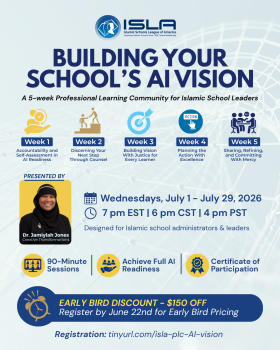
A 5-Week Professional Learning Community for Islamic School Leaders, Grounded in Islamic Intelligence by Design
This PLC is designed to help Islamic school leaders move beyond short-term reactions toward building a thoughtful, values-centered institutional vision for AI integration.
Early bird registration is available through June 22nd with $150 off registration.
Learn more and register here.
