
We’re pleased to share this timely back-to-school reflection from Asmaa Albadawi, Founder & Instructional Coach at Reach & Teach, an ISLA corporate member and partner professional development provider. In this piece, Asmaa explores how Islamic schools can create a welcoming, joyful, and meaningful first-day experience for students and families—and why those first moments can leave a lasting impact.
The views and perspectives expressed in this article are those of the author.
It was August 2008, about a week before the first day of school, and I was sitting at my desk at the Islamic School of Greater Kansas City, taking a break from setting up my classroom. It was my first year teaching, and I would be teaching fourth grade.
I was using that break to prepare “Welcome to 4th Grade!” postcards for each of my twenty-four students. I wrote a personalized, handwritten note to every child introducing myself and telling them how excited I was to meet them and have them in my class. I bought the stamps, addressed every card, and mailed them out. Needless to say, my hand hurt by the time I was done.
Then came the first day of school – my first day of teaching.
I stood at my classroom door waiting for my first-ever class to arrive, so nervous that I didn’t notice I had been slapping a stack of “Welcome to 4th Grade!” pencils against my hand until it started bleeding.
Then the students started coming in.
“Sister Asmaa, I got your card in the mail!” one after another told me, smiling. Even parents stopped to tell me how excited their children had been because of those postcards.
My hand may have hurt from writing all those cards—and from nervously slapping those pencils against it—but I forgot the pain. Seeing their excitement helped calm me down, too.
After all, I was an adult, and I had been so nervous I practically injured my own hand waiting for them to arrive. Imagine how the children might have been feeling. And for some of our youngest students, this isn’t just the first day of a new school year. It’s their first day of school ever. Their very first experience of what “school” feels like.
And don’t let the teenagers fool you, either. They get nervous too. We go to college nervous. We enter unfamiliar rooms wondering where to sit, who we’ll know, and whether we’ll fit in. Why would we expect a fourteen-year-old to feel any differently?
Eight years later, one of my former fourth graders approached me at her high school graduation. “Sister Asmaa, guess what I brought with me?” She showed me the postcard! She had kept it all those years and said it always meant so much to her. It warmed my heart more than I can describe!
It is easy to underestimate how much those first moments of the school year can mean to a child. At an Islamic school, those first moments may carry even more weight. For many children, a full-time or weekend Islamic school may be one of their first meaningful connections to the masjid or Muslim community, or their first regular experience with Muslim adult authority figures outside their family.
Some families arrive at the Islamic school already committed to it. Others are testing the waters, wondering, Is this really the right place for my child? The new children themselves may be wondering, What’s it like here?
Children thrive when they feel safe and when they feel they belong. And that feeling—or its opposite—can begin quite literally from the moment their car pulls into the parking lot on the first day of school.
Energy is contagious, and what we do on that first day can affect the tone and mood for everyone. Sometimes we slip into seriousness without realizing it. The building looks like any ordinary day. Students enter to the morning duaas in a solemn tone. An adult immediately corrects someone’s uniform. A new student is assumed to know where to go because most other students have been there for years. Then, right after duaas: “Go to class,” and often straight down to business and curriculum in class.
None of these things come from bad intentions. Morning duaas are important and something to be proud of in our Islamic schools. Uniform policies matter. Procedures need to be taught. Curriculum is important. But they do not have to be the first message our students receive.
The first message can be joy: Welcome back! We missed you! We’re excited you’re here! Masha’Allah, you’ve grown!
The first day should feel different from an ordinary Tuesday in November. It should be a day of celebration! Decorations, welcome signs, nasheeds, goodie bags, prizes, balloons! Some happy staff outside as cars pull in! Smiles, hugs, high fives, showing visible excitement to see students again!
And this should be intentional at the school level, not dependent on individual teacher personalities. Administration should lead the building-level welcome, with PTO and support staff playing a major role and teachers participating as part of the team. Teachers can then carry that same spirit into their classrooms through greetings, activities, community building, and personal touches.
The welcome can even begin before the first morning. It doesn’t have to be postcards – use social media! Post an energetic welcome-back video from the principal. Show teachers smiling and waving. Share clips of classrooms being prepared. Give students and their families something to anticipate!
For younger students, Meet the Teacher Night should also help the child meet the teacher. Yes, parents need logistical information, but talk to the child. Learn their name. Show them their space. Help them leave thinking, My teacher knows me. I belong here. I’m excited!
Warmth, joy, enthusiasm, and playfulness do not take away from the Islamic environment we are trying to create. Look at how Prophet Muhammad (PBUH) interacted with children. He initiated salam with them. He noticed them and engaged with what mattered to them. With little Abu ʿUmayr, the Prophet (PBUH) knew about the boy’s bird and spoke to him about it. He entered the child’s world rather than always expecting the child to enter the adult world. And we should embody that balance:
Salam and smiles. Duaa and excitement. Adab and joy. Expectations and celebration.
Whether this is your first year and you are terrified or your thirtieth year and you feel like you have seen it all, remember: for students and families, it is still the first day of school.
My hand hurt writing those postcards all those years ago, but when I saw those children come in smiling and excited, it was worth it. Maybe my hands are hurting typing this article right now too. But if even one Islamic school takes these words to heart and makes that first arrival warmer, more joyful, more energetic, and more welcoming, the hand pain will be worth it this time, too, insha’Allah.
As our students and families pull into the parking lot and walk through the school doors on the first day (and you know what? Each and every day!), let the message they receive be:
“We’re so glad you’re here!”
So that they feel:
“Alhamdulillah that we chose here.”
May Allah make this new school year filled with barakah, warmth, and joy. Ameen.
______________________________
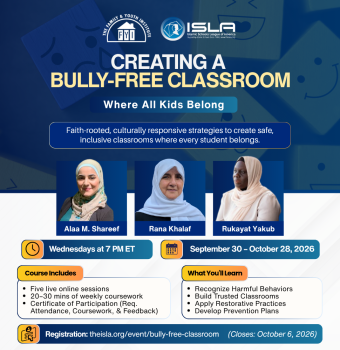
ISLA x FYI: Creating a Bully-Free Classroom – Where All Kids Belong
As Asmaa reminds us, the way students feel when they walk through the school doors matters. Creating a sense of belonging goes beyond the first day; it means building classrooms where students feel safe, heard, respected, and valued throughout the school year.
Take the next step with ISLA x FYI: Creating a Bully-Free Classroom – Where All Kids Belong, a five-session PLC exploring faith-rooted, culturally responsive strategies to prevent bullying and create more inclusive Islamic school environments.
September 30 – October 28, 2026 | Online via Zoom
Early Bird ends August 31 – save $150!
Register for the PLC: theisla.org/event/bully-free-classroom/
